 Folder 84
US
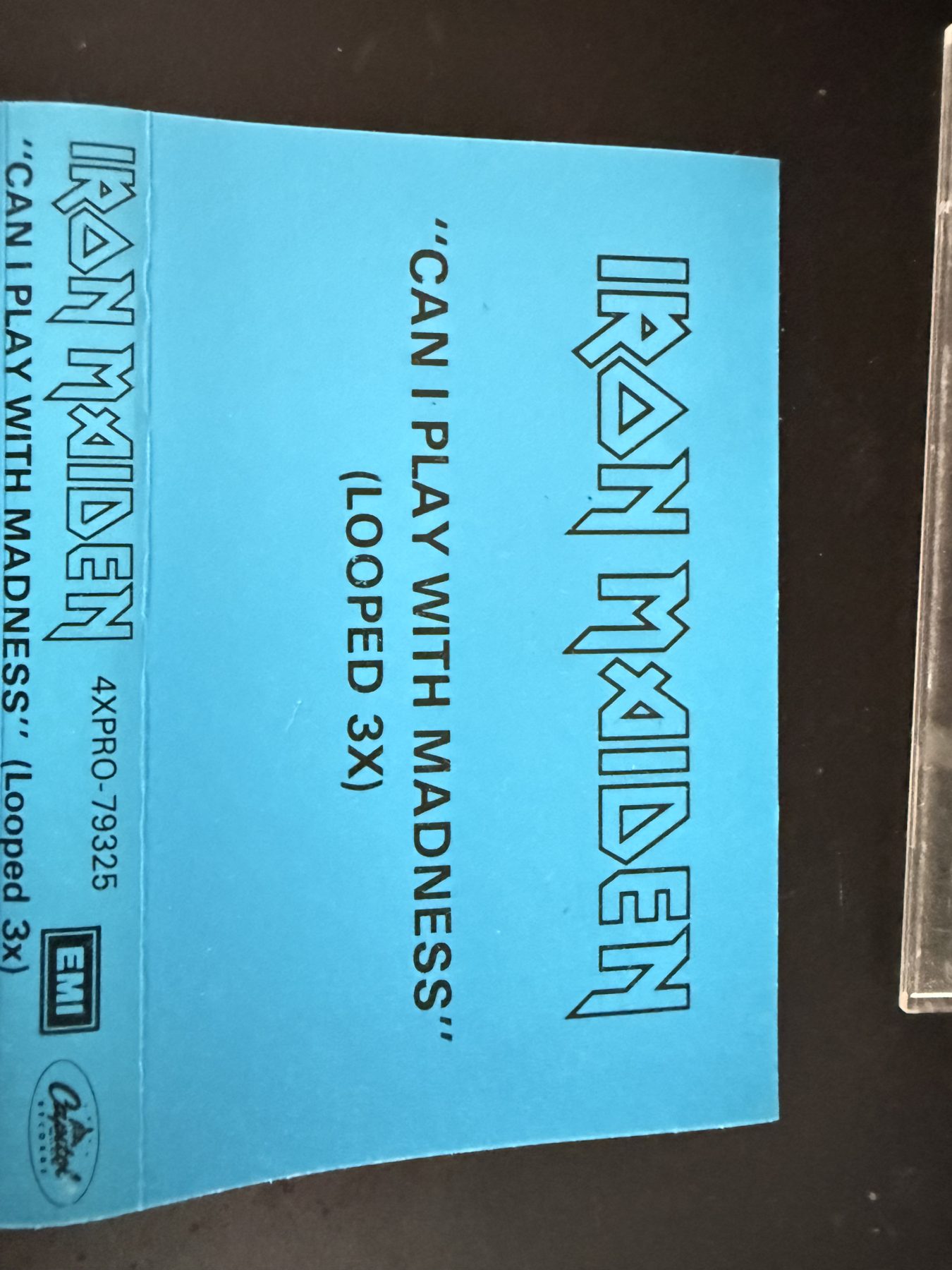
4XPRO-79325 - a Capitol promo catalogue number, and it returns nothing in this master. 4XPRO is Capitol's cassette-promo prefix; the retail album is C4-90258 and the retail club edition C4-590258.
What the record says
Every line below was read off a native-resolution crop of the photograph named beside it.
Every line of small print, and the photograph it came from — 5 of them
Inlay, laid flat: a plain blue card with IRON MAIDEN in the band logo over “CAN I PLAY WITH MADNESS” and (LOOPED 3X)
IMG_1637.jpeg
Inlay foot: IRON MAIDEN, 4XPRO-79325, an EMI logo and the Capitol Records roundel, over “CAN I PLAY WITH MADNESS” (Looped 3x)
IMG_1637.jpeg
Inlay rear: Produced, Engineered and Mixed by Martin Birch. and Repeated on both sides for your convenience.
IMG_1638.jpeg
Shell, side 1: clear plastic printed in white - IRON MAIDEN, “CAN I PLAY WITH MADNESS” (Looped 3x), 4XPRO 79325, Side 1, an EMI logo and the Capitol Records roundel
IMG_1639.jpeg
Shell, side 2: the same printing, Side 2 - the same programme on both faces, as the card says
IMG_1640.jpeg
The photographs
IMG_1637.jpg1 of 4READ FROM
The object, and what marks it out
Sleeve, labels and inserts
- Shell - clear plastic with white on-body print, no paper label.
- Inlay - a single unfolded blue card, printed one side, with no artwork and no barcode. Radio-promo packaging rather than retail.
- Programme - one song, looped three times, identical on both sides. That is what a station copy was for.
- Condition - card clean with a light crease; shell clean.
What distinguishes this pressing
4XPRO-79325- a Capitol promo catalogue number, and it returns nothing in this master.4XPROis Capitol's cassette-promo prefix; the retail album isC4-90258and the retail club editionC4-590258.(Looped 3x)andRepeated on both sides- the object states its own purpose. No album release does this.- Capitol Records as the label - the basis for filing this as US. There is no
made instatement anywhere on the card or the shell, so the country rests on the label's own nationality and the4XPROpromo convention, not on a printed line. Flagged in the title accordingly. - Martin Birch's production credit - correct for the album and for this single, and therefore no help in placing it.
- No barcode, no artwork, no tracklist - the three things every other cassette in this collection is identified from are simply absent.
Eight tracks, two sides, and the recording credits
Side A
- A1Moonchild
- A2Infinite Dreams
- A3Can I Play With Madness
- A4The Evil That Men Do
Side B
- B1Seventh Son Of A Seventh Son
- B2The Prophecy
- B3The Clairvoyant
- B4Only The Good Die Young
Bruce Dickinson - vocals · Dave Murray - lead and rhythm guitar · Adrian Smith - lead and rhythm guitar, synth · Steve Harris - bass, string synth · Nicko McBrain - drums.
Produced, engineered and mixed by Martin Birch. Mastered by George Marino at Sterling Sound, New York. Recorded at Musicland Studios, Munich. Sleeve illustration, concept and design by Derek Riggs (with Rod Smallwood). Inner-sleeve photograph by Ross Halfin. Published by Zomba Music Publishers Ltd.
Personnel and studio credits are sourced from Discogs release 576952, the UK original, and apply to the recording rather than to this pressing. The producer, publisher and copyright lines are independently corroborated by this copy's own label, quoted above.
Condition, from the photographs
A photograph cannot grade a record - this is a description of what is visible, not a grade.
- Case/inlay: general handling wear with some edge and corner softening; no cracks or splits visible in these shots.
- Shell: light surface marks and handling wear are visible. No visible warping, tape spillage or shell damage in these photographs.
Nothing on this page comes from playing the record. No Goldmine grade is claimed for it, or any other. I have no record of where this copy came from.
What is settled, and what is not
Decided, and the answer is that it belongs to a different master. This is a radio station's copy of one song, and every string on it is clean: 4XPRO-79325, Can I Play With Madness, (Looped 3x), Repeated on both sides for your convenience.
None of it can match master 19182, because that master is the album and this is a promotional single. The grade No match is the accurate one - the evidence is legible and it fits nothing here - but it should be read for what it is: not a failed identification, a correctly identified object sitting outside the candidate list this collection is built against.
It is kept on the shelf because the project's scope is the era rather than the album alone, and Can I Play With Madness is one of the four era singles.
Half of what that last paragraph asked for has now been done (2026-09-18). The owner identified this copy as Discogs 5346227, and that release was fetched and read: US, Capitol Records, catalogue 4XPRO / 79325, 'Cassette, Single', notes Promo Cassingle, and a tracklist of Can I Play With Madness (Looped 3x) twice over. Its master, 19236, was fetched too and its 54 versions are committed beside the album masters - which is what lets this file name the release at all, since the build gate only accepts a release id belonging to some master on this shelf.
What has NOT changed is the grade, and it should not. No match here has never meant "unidentified": it means this object is not a version of master 19182, the album every other dossier in this tree is written against, and fetching a different master does not make it one. The header still resolves to no release for the same reason - a release id in that row is checked against this album's own version list, and 5346227 is not in it. The identification lives in this prose instead, where it is true without pretending to be something the album's candidate list can carry.
What would change the grade now: filing the four era singles as albums in their own right, the way albums.py already holds the studio and live records, so that this copy gets a candidate list of its own to be graded against. That is a registry change plus a transcribed dossier per single, and it is still a separate job.