 Folder 72
UK
The moulded GTS monogram on the shell rail - the discriminator. Only 34636660 of the three UK rows records G.T.S. (Fabrications) Limited, and it records it three separate ways: in the format text, in the notes, and as a credited company.
What the record says
Every line below was read off a native-resolution crop of the photograph named beside it.
Every line of small print, and the photograph it came from — 9 of them
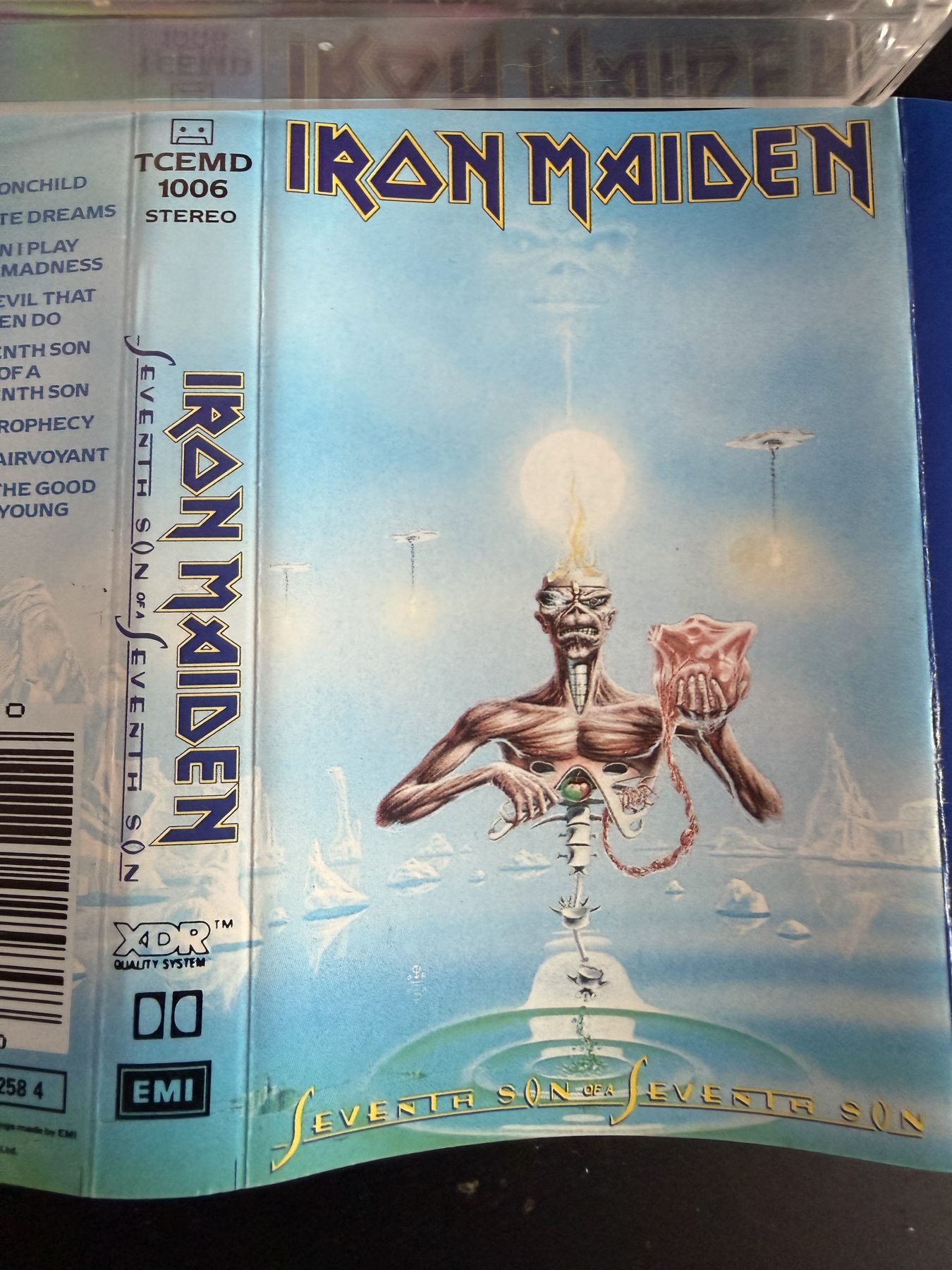
Inlay front and spine: boxed XDR over TCEMD 1006 / STEREO, IRON MAIDEN over SEVENTH SON OF A SEVENTH SON, a Dolby device and an EMI logo
IMG_1510.jpeg
Inlay rear panel: the eight titles in the album's running order, the barcode 0 77779 02584 8, 79 0258 4, and the two lines Printed in England / Manufactured in England
IMG_1511.jpeg
The same rear panel from the other side, showing the two oval punch holes through the card and the ℗ 1988 Original Sound Recordings made by EMI Records Ltd line above them
IMG_1512.jpeg
Lyric U-card, colour side: the eight titles with writing credits over the wise-man illustration, and the full production credits panel
IMG_1515.jpeg
Lyric U-card, black-and-white side: printed lyrics for all eight songs across the fold
IMG_1516.jpeg
Lyric U-card, technical panel: the XDR mastering and duplicating notes ending EMI Records Ltd, Hayes, Middlesex, England and Manufactured in the UK by EMI Records Ltd. Made and printed in the UK.
IMG_1519.jpeg
Shell, side 1: clear plastic printed in white - TC-EMD 1006, ℗ 1988 Original sound recordings made by EMI Records Ltd, an EMI logo, See Inlay Card For Details, a DOLBY SYSTEM device, and a large 1
IMG_1521.jpeg
Shell, side 1, bottom rail at native resolution: a moulded boxed GTS monogram and the cavity code B-5 - the discriminator
IMG_1521.jpeg
Shell, side 2: the same printing with a large 2 and the cavity code B-4
IMG_1522.jpeg
The photographs
IMG_1510.jpg1 of 13READ FROM
The object, and what marks it out
Sleeve, labels and inserts
- Shell - clear plastic with white on-body print, no paper label, red pressure pad spring visible through the window.
- Inlay - the standard artwork J-card, plus a separate ten-page U-card carrying the lyrics in black-and-white on one side and the credits in colour on the other.
- Two oval punch holes through the rear panel of the J-card - a deletion/cut-out mark, not part of the printing.
- Condition - card lightly rubbed at the spine folds; shell clean and the moulded codes fully legible.
What distinguishes this pressing
- The moulded
GTSmonogram on the shell rail - the discriminator. Only 34636660 of the three UK rows records G.T.S. (Fabrications) Limited, and it records it three separate ways: in the format text, in the notes, and as a credited company. - The ten-page lyric U-card - excludes 35539744, which is recorded with a five-panel U-card. It does not separate 34636660 from 2393944: both record the ten-page card, which is why the moulding is the deciding evidence and not this.
- Cavity codes
B-5/B-4- read off the object, and useful mainly as the control for folder 77, whose rail carriesC3 13and no monogram at all in the same place. - Barcode
0 77779 02584 8- recorded identically by all three UK rows. Corroboration, not a discriminator; the skill's own table lists a barcode as shared across pressings of one commercial release. Printed in England/Manufactured in England- recorded verbatim by all three rows. Establishes country, separates nothing.
Eight tracks, two sides, and the recording credits
Side A
- A1Moonchild
- A2Infinite Dreams
- A3Can I Play With Madness
- A4The Evil That Men Do
Side B
- B1Seventh Son Of A Seventh Son
- B2The Prophecy
- B3The Clairvoyant
- B4Only The Good Die Young
Bruce Dickinson - vocals · Dave Murray - lead and rhythm guitar · Adrian Smith - lead and rhythm guitar, synth · Steve Harris - bass, string synth · Nicko McBrain - drums.
Produced, engineered and mixed by Martin Birch. Mastered by George Marino at Sterling Sound, New York. Recorded at Musicland Studios, Munich. Sleeve illustration, concept and design by Derek Riggs (with Rod Smallwood). Inner-sleeve photograph by Ross Halfin. Published by Zomba Music Publishers Ltd.
Personnel and studio credits are sourced from Discogs release 576952, the UK original, and apply to the recording rather than to this pressing. The producer, publisher and copyright lines are independently corroborated by this copy's own label, quoted above.
Condition, from the photographs
A photograph cannot grade a record - this is a description of what is visible, not a grade.
- Case/inlay: general handling wear with some edge and corner softening; no cracks or splits visible in these shots.
- Shell: light surface marks and handling wear are visible. No visible warping, tape spillage or shell damage in these photographs.
Nothing on this page comes from playing the record. No Goldmine grade is claimed for it, or any other. I have no record of where this copy came from.
What is settled, and what is not
Settled on a plastics-maker's mark, with a second copy on the shelf as the control. The catalogue number returns three UK rows that agree on country, label, barcode and manufacturing statement. Two of them also agree on the ten-page lyric card, so the card narrows the field to two and then stops.
What decides it is moulded rather than printed: a boxed GTS monogram in the bottom rail of the shell, which 34636660 alone records. This is the kind of evidence the skill calls a real discriminator - a plant mark, not a territory-wide one.
The reading is negative-evidence-proof because the collection holds the counter-example: folder 77 is the same UK issue with the same card, and a native-resolution crop of its rail - screw to screw, the whole width - carries C3 13 and no monogram. Two shells photographed the same way, one with the mark and one without, is a stronger reading than either on its own.
Standing caveat: a UK pressing absent from Discogs cannot be excluded.