 Folder 45
US
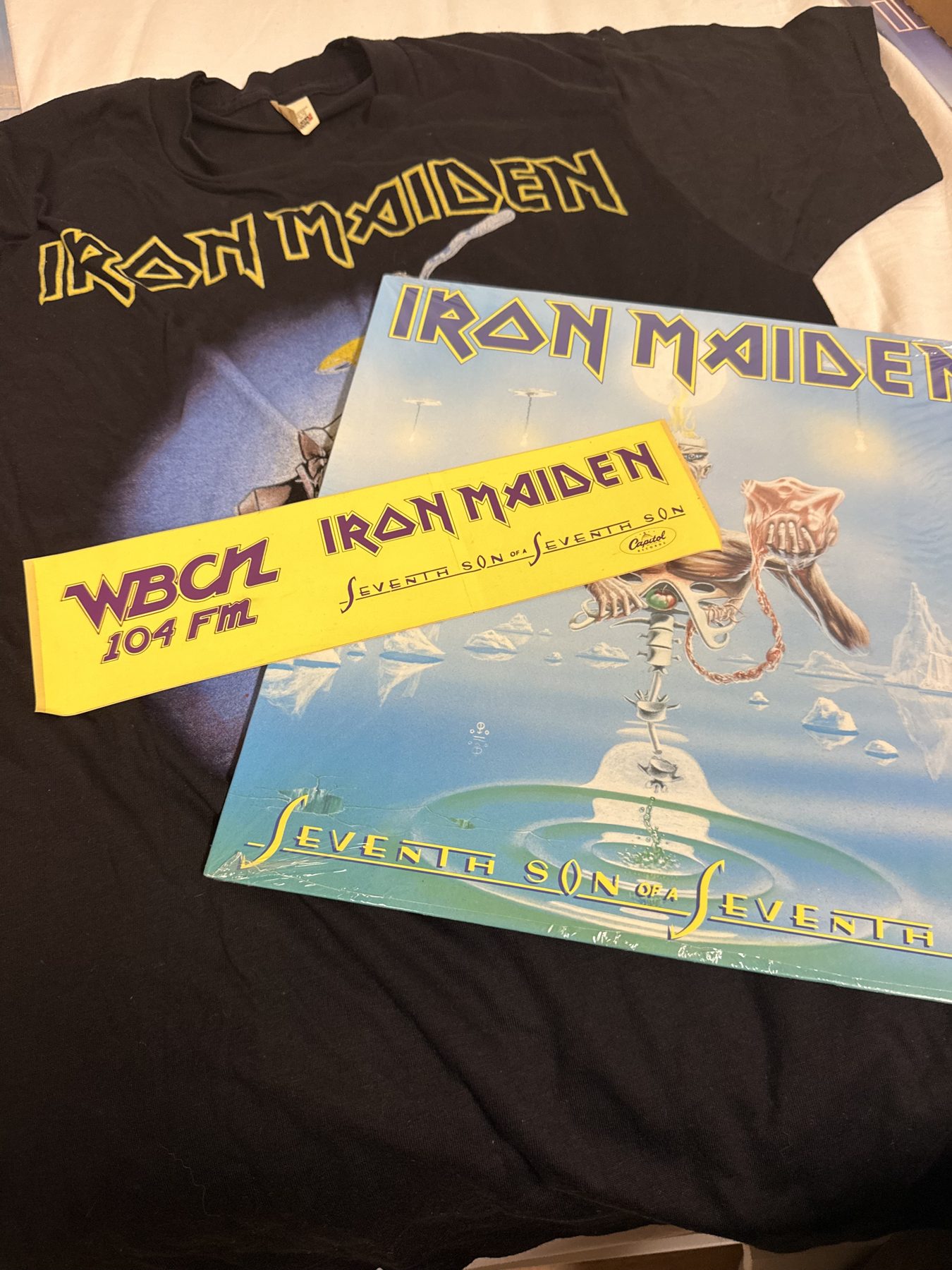
Three objects in one folder - the LP, a Can I Play With Madness t-shirt and a WBCN 104 FM bumper sticker. Drilled jacket, still in shrink wrap. Owner's account: won in a 1988 WBCN contest.
What the record says
Every line below was read off a native-resolution crop of the photograph named beside it.
Run-out photographed but only partly legible. C1-1-90258 and C1-2-90258 are clear, with Sterling, DMM, an SP 2-… fragment and the hand-etched IF YOU DON'T LIKE IT BOLLOCKS. Every one of those is shared by both American candidates. The marks that would separate them - SP-AR and a Δ stamp - are not resolved.
Every line of small print, and the photograph it came from — 16 of them
Run-out, side A, etched: C1-1-90258
image00029, image00030
Run-out, side B, etched: C1-2-90258
image00033
Run-out, etched: SP 2-…
image00025
Run-out, hand etched: Sterling
image00040
Run-out, hand etched: IF YOU DON'T LIKE IT B…
image00036, image00037, image00038
Label: the eye/Eddie artwork
image00041, image00042
Front sleeve: ℗1988 Original Sound Recordings made by EMI Records Ltd, ©1988 Iron Maiden (Holdings) Ltd.
image00045
Rear sleeve: Manufactured by Capitol Records, Inc., A Subsidiary of Capitol Industries-EMI, Inc., Hollywood and Vine Str…, …Printed in U.S.A.
image00046
Rear sleeve barcode
image00048
Rear sleeve: a drilled hole through the lower corner, beside the printed C1-90258
image00047, image00049
Inner sleeve, blue side: lyrics, band photograph and C1-90258, with a die-cut spindle hole at the corner
image00043
Inner sleeve, reverse: the seer-and-crystal-ball painting, the same spindle hole showing
image00044
**T-shirt front: the Can I Play With Madness artwork - a corkscrew fist smashing through Eddie's severed head**
image00023, image00024
T-shirt front, printed: ©1988 IRON MAIDEN(HOLDINGS) LTD
image00022
T-shirt neck tag: L/G, 50% COTTON/COTON, 50% POLYESTER, MADE IN/FAIT AU, CANADA, AF-13, SCREEN STARS - the character read as 1 is a bare vertical stem with no flag, so AF-I3 cannot be excluded
image00021
Bumper sticker, yellow: WBCN 104 FM · IRON MAIDEN Seventh Son of a Seventh Son · Capitol RECORDS
image00020, image00024
The photographs
image00020.jpg1 of 31READ FROM
The object, and what marks it out
Sleeve, labels and inserts
- Outer sleeve - standard artwork with an American rear, still inside shrink wrap. Whether that is the factory wrap or a later rewrap is not something these photographs show. The record has plainly been out of it: this folder photographs both labels and the run-out.
- A drilled hole through the lower corner of the jacket, next to the printed catalogue number. Recorded as observed; whether it marks promotional stock or deleted stock is not something a photograph settles.
- Inner sleeve - printed both sides: blue lyrics, credits and a band photograph on one, the seer-and-crystal-ball painting on the other, with a die-cut spindle hole.
- Labels - the eye/Eddie artwork.
- Vinyl - black, with a visibly worn deadwax.
- T-shirt - black,
L/G, on a Screen Stars 50/50 blank made in Canada. The front carries the Can I Play With Madness artwork and©1988 IRON MAIDEN(HOLDINGS) LTDprinted beside it. It is era merchandise, not a pressing: it is part of what was won, and it contributes nothing to the grade. - Bumper sticker - yellow with purple print,
WBCN104 FMon one half andIRON MAIDENSeventh Son of a Seventh Sonwith the Capitol Records oval on the other. Creased once across the middle.
What distinguishes this pressing
C1-90258- the American catalogue number, shared with the Canadian pressing (folders 5 and 26) and distinguished from it by the sleeve.- A deadwax that is worn where it matters. The fragments that do read --
C1-1-90258,C1-2-90258,Sterling,SP 2-…-- are forms both American candidates use, and the marks that would separate them are not among them. - The only bundle in this collection, and the only garment. Every other folder here is a record and its paper. This one is a record, a t-shirt and a radio-station bumper sticker that arrived together.
- The only drilled jacket here, and the only sleeve still in its shrink wrap.
Eight tracks, two sides, and the recording credits
Side A
- A1Moonchild
- A2Infinite Dreams
- A3Can I Play With Madness
- A4The Evil That Men Do
Side B
- B1Seventh Son Of A Seventh Son
- B2The Prophecy
- B3The Clairvoyant
- B4Only The Good Die Young
Bruce Dickinson - vocals · Dave Murray - lead and rhythm guitar · Adrian Smith - lead and rhythm guitar, synth · Steve Harris - bass, string synth · Nicko McBrain - drums.
Produced, engineered and mixed by Martin Birch. Mastered by George Marino at Sterling Sound, New York. Recorded at Musicland Studios, Munich. Sleeve illustration, concept and design by Derek Riggs (with Rod Smallwood). Inner-sleeve photograph by Ross Halfin. Published by Zomba Music Publishers Ltd.
Personnel and studio credits are sourced from Discogs release 576952, the UK original, and apply to the recording rather than to this pressing. The producer, publisher and copyright lines are independently corroborated by this copy's own label, quoted above.
Condition, from the photographs
A photograph cannot grade a record - this is a description of what is visible, not a grade.
- Sleeve: still inside shrink wrap, so the card itself is barely visible; the wrap is creased and has lost its tension. A hole is drilled through the lower corner of the jacket.
- Vinyl: light surface marks and handling sheen catch the light. No visible deep scratches, warping or edge damage in these photographs. The labels are clean and unmarked, and the deadwax is visibly worn.
- T-shirt: the print is unbroken and uncracked in these shots; the neck tag is intact and legible. No holes or stains are visible, but only the front and the neck were photographed.
- Sticker: loose and unstuck in these shots, with one crease across the middle and no tears at the edges. Its adhesive face was not photographed, so whether it has ever been peeled is unknown.
Nothing on this page comes from playing the record. No Goldmine grade is claimed for it, or any other.
What is settled, and what is not
Narrowed to two. The US is certain and C1-90258 is legible on both sides of the deadwax. The master holds two 1988 American vinyl entries under that number and Discogs separates them by pressing plant:
How the other candidates were ruled out
| Candidate | Plant | What Discogs records | Verdict |
|---|---|---|---|
| 1763028 | SRC | E A S T embossed on the side two label around the spindle hole | Not visible in these photographs. |
| 10665279 | Allied | SP-AR and a Δ19983 stamp on some side A variants | The run-out shows an SP 2-… fragment; whether SP-AR follows is not resolved. |
Everything this copy does show - C1-1-90258, C1-2-90258, Sterling, DMM, the IF YOU DON'T LIKE IT BOLLOCKS etching - appears in the recorded run-out variants of both, so none of it discriminates.
And the run-out may not be able to settle it at all. Discogs caches four run-out variants for the Allied pressing, and its variant 4 carries neither SP-AR nor the Δ stamp: C1-1-90258-Z2-DMM 1-3 Sterling on side A, which is character-for-character a form the SRC pressing also records. So the presence of SP-AR would point to Allied, but its absence would prove nothing.
What would settle it: the E A S T embossing around the side two label's spindle hole. That is the one tell Discogs attaches to a single candidate rather than to some of its variants, and it needs no equipment beyond a lamp held low. Its absence would be weaker evidence than its presence, but it is the best test available on the object.
Already attempted from the photographs, and it did not work. image00042 is the side two label and shows the spindle hole clearly. Cropped at native resolution, converted to greyscale and pushed hard on contrast, nothing that reads as E A S T appears around the hole. That is not evidence of absence: the frame is flat, front-lit, and an embossing is a relief that shows only when the light rakes across it. Recorded here so nobody repeats the crop expecting a different answer. The test still needs the record and a lamp held low.
Standing caveat: this method cannot exclude a pressing absent from Discogs.